Multicollinearity Explained: Why Correlated Predictors Confuse Your Model
July 19 2026 • 2 min read


Image by AI
Multicollinearity occurs when two or more independent variables in a regression model are highly correlated with one another. At first glance this may not seem like a problem — after all, if two variables are related, shouldn't they both help explain the outcome? The issue is that the model struggles to tell which variable is actually responsible for the observed association.
The Problem: Two Variables, One Signal
Imagine trying to determine whether income or wealth has a stronger relationship with a health outcome. Since the two are closely related, the model finds it difficult to separate their individual contributions.
As a result:
- Regression coefficients become unstable.
- Standard errors increase.
- Confidence intervals become wider.
- Variables that may genuinely be associated with the outcome can appear statistically non-significant.
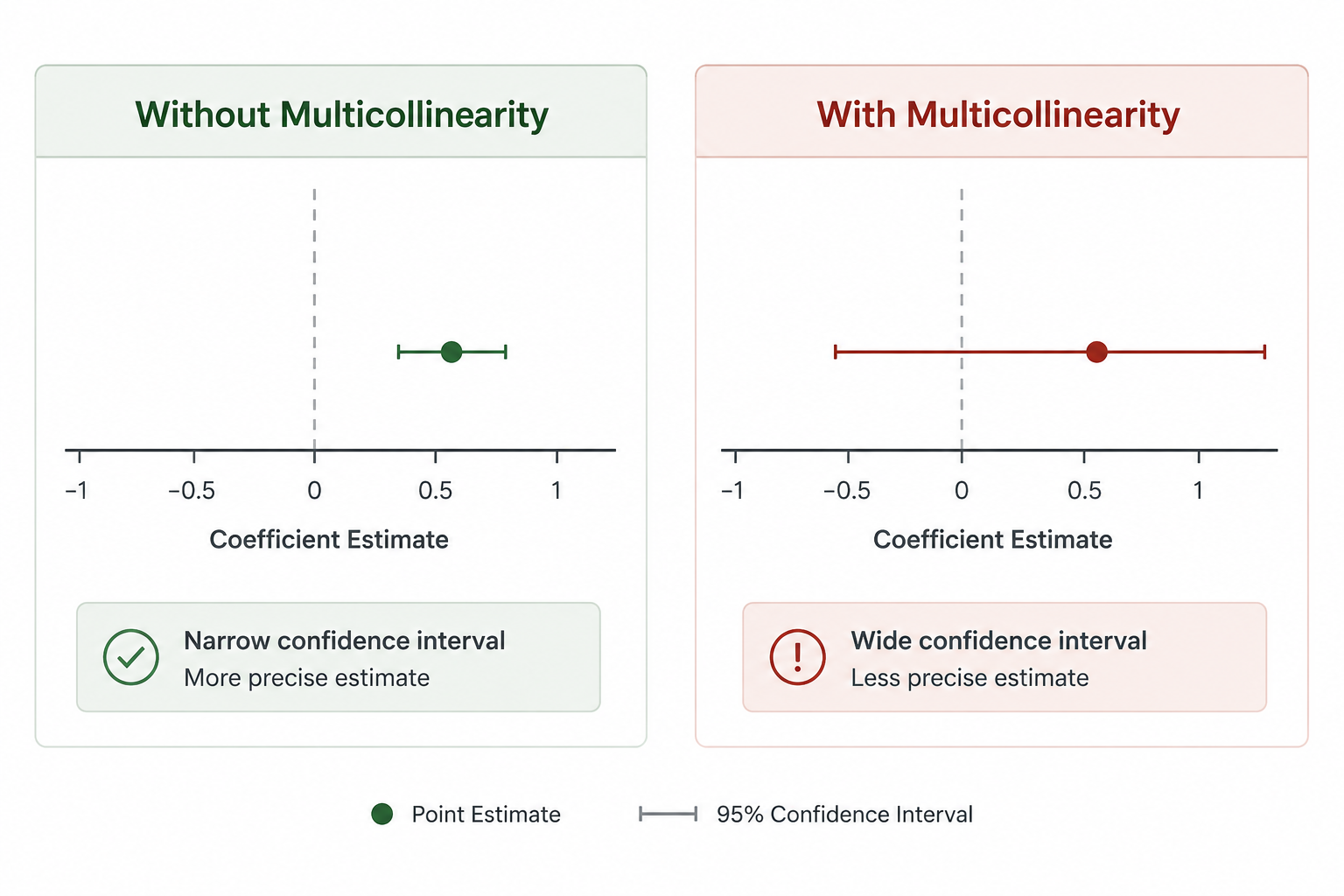
Prediction vs. Interpretation
Multicollinearity doesn't necessarily reduce the model's ability to make predictions. What it affects is our confidence in interpreting the individual regression coefficients. A model can still fit the data well while the story it tells about any single predictor becomes unreliable.
How Researchers Detect It
- Variance Inflation Factor (VIF): the most commonly used diagnostic. Higher values signal greater redundancy between predictors.
- Correlation matrix: checking correlations between predictor variables before building the model is a useful first step.
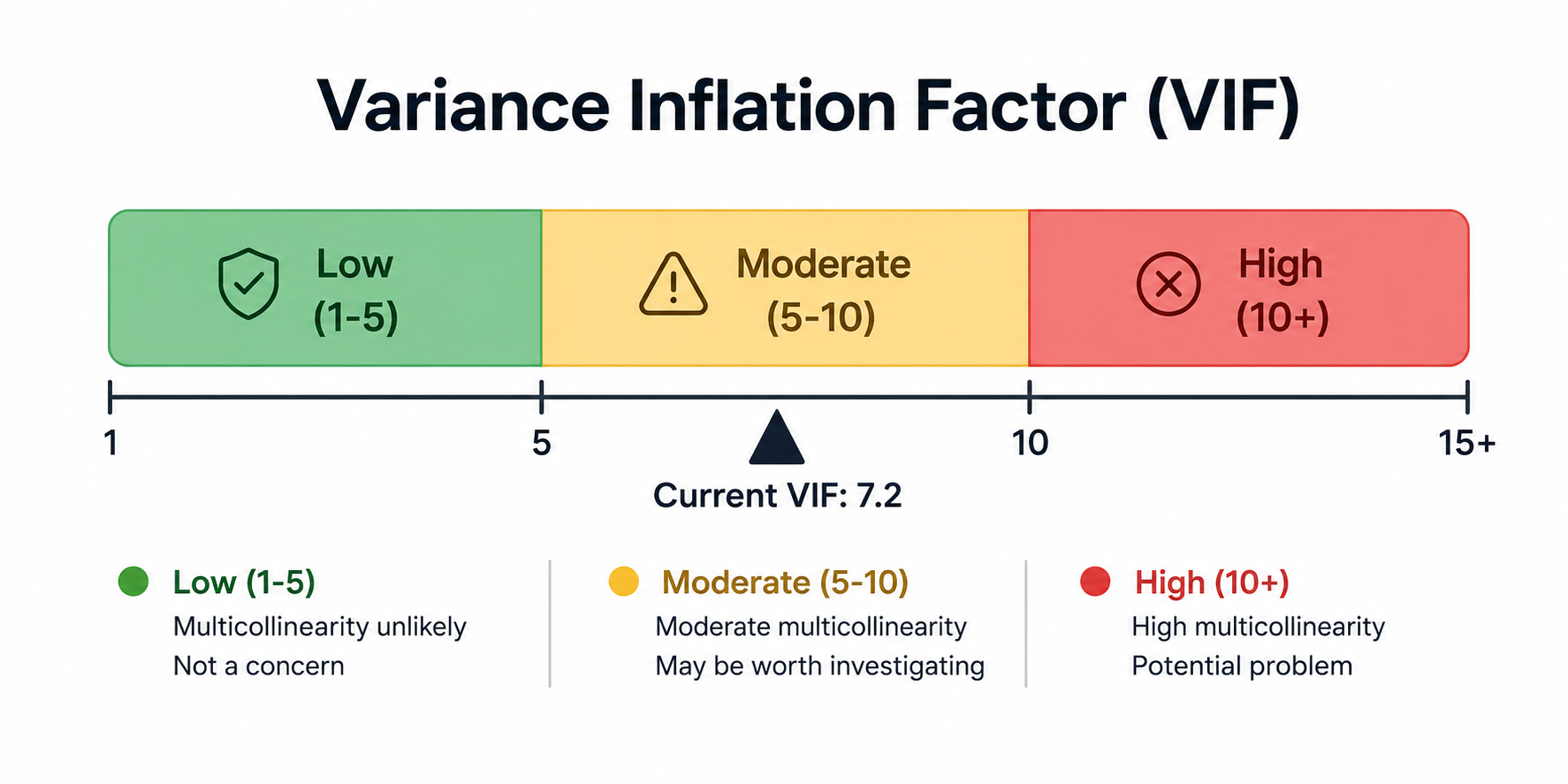
What To Do About It
If multicollinearity is identified, researchers may decide to:
- Remove one of the correlated variables.
- Combine them into a single composite measure.
- Use other modelling approaches, depending on the research question.
💡 The Bottom Line
Regression models don't just require the right statistical test — they also require the right variables. Before interpreting individual coefficients, ask yourself whether your predictors are measuring distinct concepts or simply different versions of the same thing.
Check your correlations. Compute your VIF. Interpret with care.